

Unfinished Business: The Fleet Model 1 Story

Updated: May 2, 2025

People who love old airplanes, old cars, houses, or other tangible reminders of the past are often dreamers who conjure images in their imaginations of a time simpler, more beautiful, or perhaps just more interesting than the present. Unlike those who dream about the future, with its gauzy promise of things bigger than today, those who look backward, and especially those who set out to recreate instead of creating, the antique lover is different.
I never met Paul Seibert, but I have come to believe I know him, even if just a little, through meeting many of his friends and loved ones, but also from reading his voluminous notes, scanning his meticulous photographs, and most especially from becoming intimately acquainted with the 1929 Fleet Model 1 that he left behind – almost finished. That is, of course, what drew me to Paul in the first place, and in my desire to know more about this beautiful machine from the 1920's I came to learn about the man who dreamed of bringing it back to life.
His wife Marilyn told me that on their first date, Paul told her that he wanted to find an old airplane in a barn that he could restore. He'd given it a lot of thought and specified that the plane would be small enough and he could do it himself. Finding a set of blueprints for the Great Lakes 2T1 in his files tells me that he wasn't as much committed to a specific brand, or model of airplane, as he was to an idea. I can imagine Paul saying "Eureka" when he saw the guano-covered wreck he found in a northern California barn. Unlike anyone else who may have stumbled upon it before he saw not a disgusting, filthy mess as much as his own destiny.
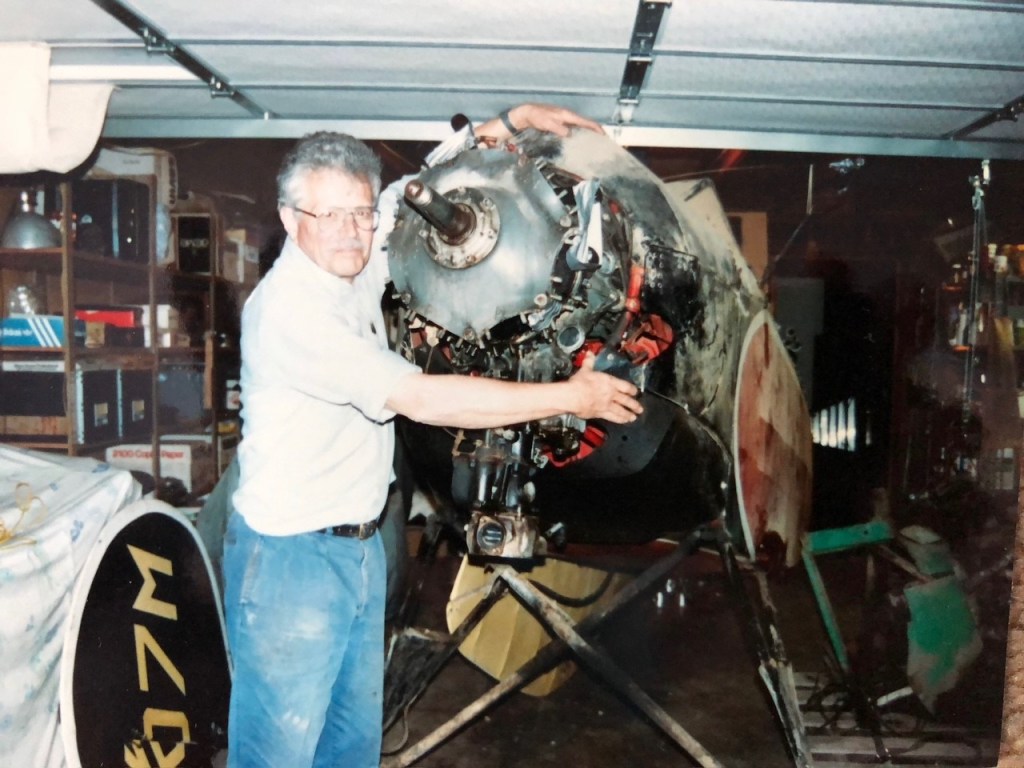
After dragging it from the place it had lain for over thirty years Paul set about the task that would take much of his time for the next thirty years. He was an engineer as well as a dreamer and his files indicate a methodical, and meticulous search for the real history of the airplane he set about recreating. I asked Marilyn if she knew how much time he spent restoring NC 607M and while she didn't have a number, she mentioned that he spent a few hours on it every day. Together, with a calculator we came up with an estimate I think the man of slide rules and precision could generally find acceptable: 10,000 hours.
I have a photo Marilyn shared of Paul, wearing white coveralls with the Curtiss Aircraft logo on the back, carrying a toolbox as he headed to his workshop to pursue his future by working on the past.
In another photo, Paul has thrown his arms around the Fleet's Warner 145 engine. It's obviously a pose for fun, showing Paul's sense of humor, but it tells us too that he loved this airplane he was rescuing.

As I sat under that same engine this summer at AirVenture in Oshkosh, Wisconsin, with his friend of many decades Ron Price I learned that Paul was a very private person who was tight-lipped about many things. He was frugal too, preferring to split the bill based on what each had to eat or drink as they traveled together. Ron, a Fleet owner himself, has no idea how much money Paul may have invested in the project over the years despite their close relationship.
Sparky Barnes, a noted aviation writer, who sought me out to interview about the Fleet was excited to learn that it was Paul's. She'd met him at AirVenture's in the past and spoke of what a kind man and gentle spirit he was. A person with many friends and a long-time Sonoma Skypark denizen was excited to learn the plane would be coming home later this year because it meant so much to many there on account of how they felt about Paul.
Of course, Paul didn't live to see his dust-covered dream, resurrected from a barn so long ago, fly again. Like the landscape architect who designs gardens that will take a generation or two before they mature, I think Paul knew as his time drew to a close that his dream, and his vision, would be finished by others.
Scott Woods stepped into that void after Paul passed. A man who loves the romance of aviation, especially as it comes to life with round motors, fabric-covered wings, and dripping oil he saw an opportunity to finish another's work. His wife Annie tells the story of his struggle to tell her something she already knew – that he'd bought another airplane. She laughs as she tells it, knowing it wasn't a secret, just an expression of passion about the past, and the airplanes that flew in it. Scott, with Annie's amused acquiescence, set about finishing the plane and then seeing to it that it was moved halfway across the country.
When Scott talked to me about buying the plane I wasn't sure I wanted to do that. I'm in the middle of pursuing my own aviation dream of putting all the Waco F models together in one place. But the meticulous attention to detail, as well as the obvious craftsmanship of the plane were compellingly hard to ignore. He kept talking to me about Paul Seibert as if I should know who he was, but as a relative newcomer to Sonoma Skypark, I was clueless. Until he mentioned Marilyn and then things fell into place.
After I bought the plane and talked to Marilyn, it seemed right to me that we get it home to northern California. But it seemed important too, to fulfill Paul's wish that it visit AirVenture first. I could make that happen. So, I arranged for Jared Calvert to fly the 90 miles from Brodhead to Oshkosh. This is how Ron Price and I found ourselves sitting in the shade of the Fleet's wings as dozens of admirers, including a fair number of aircraft judges came by to express their admiration for this airplane that was small enough for Paul to restore himself after he found it in a barn.


Comments