

How Did They Get to Work?

The Untold Transportation Story of Mustang Field, 1943–1944
By Tony Caldwell, Founder — The Caldwell Collection at Mustang Field
I ask it on every tour I give. I wait a beat and watch people’s faces. And every single time, the question lands the same way — like a key turning a lock that hasn’t been touched in eighty years. How did they get to work?
Mustang Field, four miles south of El Reno, Oklahoma. The year is 1943. Young men are learning to fly the Fairchild PT-19 — open cockpit, wood-winged, beautiful and demanding — over the flat prairie of Canadian County. Civilian mechanics are keeping the engines running. Instructors are walking the flight line. Office staff are filing paperwork. Ground crew are fueling the aircraft. Hundreds of people show up every single day to do the work that trained the pilots who flew the war.
They didn’t just materialize. Somebody had to get them there. And this, it turns out, is one of the most fascinating stories we get to tell here at The Caldwell Collection.
We’re building an exhibit around it. And I’m going to tell you the whole story — including the part that still gives me chills, and that I’ll admit I didn’t fully grasp until I’d been deep into this project for a while.
— THREE GALLONS A WEEK —

First, let me set the scene. Because understanding what getting to work actually meant in 1943 is the only way this story makes sense.
The Office of Price Administration divided civilian gasoline into three rationing tiers. Most people held an “A” sticker. You know what that entitled you to? Three gallons a week. Three gallons. I sometimes hold up a small gas can on tours and let that sink in for a moment.
Mustang Field sat four miles south of El Reno and about fifteen miles west of Oklahoma City. On flat Oklahoma roads at the wartime “Victory Speed” — 35 mph, the federally mandated maximum, enforced not to save gas but to save rubber after Japan took Southeast Asia — a round trip from El Reno alone ate most of a day’s ration. A round trip from Oklahoma City and back? Done. Week’s allotment gone.
The government said it plain: “When You Ride Alone, You Ride with Hitler.”
That wasn’t hyperbole. It was the organizing reality of home front life. And it’s the reason that a question as simple as “how did you get to work?” becomes, once you start pulling the thread, a story about community, sacrifice, ingenuity, and — in our case — something much more personal.
— THE RAILWAY NOBODY REMEMBERS —

Here’s the part that surprises every single visitor. Everyone.
In 1943, you could board an electric trolley car in downtown Oklahoma City and ride it all the way to El Reno. Every hour. Starting at five-thirty in the morning.
The Oklahoma Railway Company operated a 25-mile interurban electric line — stopping in Banner, Yukon, and Putnam City along the way. During World War II it was running under federal government oversight (the company had been in receivership since 1939), and the war’s transportation demands gave it a second life. Packed cars, patriotic riders, hourly service west across the Canadian County prairie.
A worker from Oklahoma City could ride it out to El Reno, then figure out the last four miles south to the field — bicycle, carpool, shanks’ mare — but the hard part of the journey was handled. They abandoned the El Reno line only in November 1946. The war was over. The pilots had gone home. The need had passed.
Now here is the part I want you to sit with for a moment.

The Oklahoma Railway Company grew out of the vision of Anton H. Classen — the man history calls the first great developer of Oklahoma City. He built the Metropolitan Railway Company, which became the Oklahoma Railway. He planted 300,000 trees in a city that had been open grassland a generation before. He laid out the diagonal boulevards that still define Oklahoma City’s street grid today.
From approximately 1910 until his death on December 30, 1922 — right through the years when the El Reno interurban line was being extended and expanded — his personal assistant was a woman named Lula Belle Morrison Caldwell.
My grandmother.

She managed the affairs of the man who built the railway that would one day carry workers to a flight training field. A field where the hangar still stands. A hangar that I now own, have restored, and have opened as a museum bearing our family’s name.
I’ll be honest — I had always known Lula Belle had worked for Classen, and I had always been proud of that. But the full weight of it — the chain from her desk to that railway to this hangar — only became clear to me when I was deep into researching this exhibit. I think I just sat there for a while when I put it together.
She helped build the railway. Her grandson restored the hangar it served.
— EVERY WAY POSSIBLE —
The interurban got a lot of people close. But close isn’t there. The workers of Mustang Field came at that last four miles — and the whole journey before it — by every means available.
Carpooling was not just encouraged — it was practically a patriotic obligation. “B” sticker holders, the essential war workers who organized carpools, received extra fuel. Neighbors coordinated shifts. Communities built informal transportation networks that connected them in ways that outlasted the war by years.

Motorcycles were a practical, fuel-efficient choice. The most likely machine in a Canadian County driveway in 1943 was a well-worn Harley-Davidson 45 cubic inch flathead — a WL, R, or D series, bought used during the Depression for under three hundred dollars. Indian Scouts were a close second on Oklahoma roads. Four miles of flat prairie road: easy work. The catch, like everything made of rubber, was that tires were rationed, too.

Cushman scooters carry the most surprising story of the bunch. Cushman Motor Works out of Lincoln, Nebraska, had started making scooters in 1936. By the time war came, their little machines were so fuel-efficient — claims of 75 miles per gallon, a penny a mile — that the federal government made an extraordinary exception: Cushman was the only motorized vehicle manufacturer permitted to sell new vehicles to civilians during the entire war. While car and motorcycle production shut down entirely in 1942, a worker in 1943 could walk into a dealer and ride home on a brand new Cushman Model 32 or 34.
Bicycles were the quiet workhorses. Four miles on a flat Oklahoma road — doable, even in the summer heat. The irony: bicycles were rationed, too. Workers who already owned one before the war were the lucky ones.
Walking was real. Four miles each way, an hour and fifteen minutes each direction, for workers living in El Reno itself. These were people who had already walked through the Dust Bowl and the Depression. Another four miles wasn’t going to stop them. Even their shoes were rationed, incidentally.
— THE VEHICLES OF A DEPRESSION GENERATION —
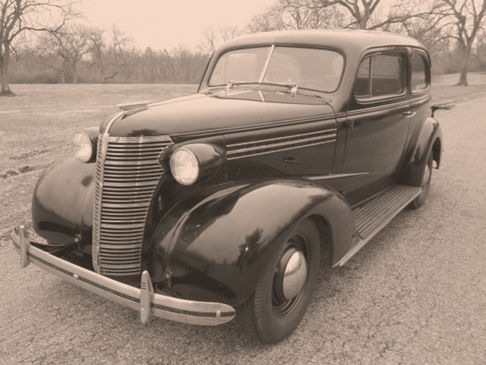
By 1943, civilian automobile production had been suspended for over a year. Every car on the road was at least a year old. Most were considerably older. And in Canadian County, which the Dust Bowl had hit hard, many of them were Depression-era machines kept running through sheer determination and mechanical ingenuity.
Chevrolet led American auto production throughout the late thirties — the 1936, ’38, ’40 Master DeLuxe sedans were everywhere. Ford’s flathead V8, introduced in 1932, had made them enormously popular. Plymouth was a distant third. In the rural parts of Canadian County, International Harvester, Chevrolet, Ford, and Dodge pickups were as common as family sedans, maybe more so.
When we put these vehicles in the exhibit, I want them honest. Not showroom restorations. Working machines. Worn paint, patched tires, the smell of old oil. Because that is what these people drove. The contrast I want visitors to feel is this: you walk past a beat-up 1938 Chevy truck in the parking area, and then you walk into a hangar full of gleaming, beautiful, lovingly preserved aircraft. That gap — between the humility of the commute and the ambition of what they were doing inside these walls — is the story of Mustang Field.
— TWO FAMILY BOOKENDS —
I’ve started and grown a number of businesses in my life. One Agents Alliance has helped build more than 250 independent insurance agencies over 25 years, with a 95% success rate. I chair Prism Bank, which made the Inc. 5000 list of fastest-growing companies. I’ve served in elected office and on boards of organizations from the Salvation Army to the Oklahoma Board of Juvenile Affairs.
But I have to tell you — nothing I’ve built has felt quite like this.
My first ride in an airplane was at two weeks old, tucked into an Aeronca Champ with my father. I didn’t learn to fly until my early twenties, took a long sabbatical while I built my businesses and raised two sons with my wife Sharon, and came back to flying in 2009. What started as a Cessna 172 became a Bonanza, then a Cirrus, a TBM, a Piaggio Avanti II. And then around 2010, at Sun ’n Fun, I walked around a corner and saw a Waco biplane for the first time. I was struck speechless. I knew in that moment I had to find one.
I eventually found my “Dream Waco” — a 1934 UMF-3, the most beautiful airplane I’d ever seen, in Dave Allen’s hangar in Coronado, California. One airplane became a collection. A collection became, somehow, a mission. And the mission became The Caldwell Collection at Mustang Field: a 501(c)(3) nonprofit, established in 2024, housed in a restored 1943 WWII hangar, opened to the public in October 2025.. I funded the hangar restoration and initial collection personally, as a gift to the community of El Reno, the State of Oklahoma, and aviation lovers everywhere.
Lula Belle Morrison Caldwell — my grandmother — sat at the desk of Anton Classen for over a decade while he was building the infrastructure of modern Oklahoma City. She was there when the El Reno interurban line was being extended. She managed the affairs of the man who made it possible for workers to ride a trolley west across the prairie to a field that didn’t yet exist — and that I would, eighty years later, restore and open as a museum.
She didn’t know. I didn’t know. History just folded back on itself, the way it sometimes does when you’re paying attention.
She helped build the infrastructure that served this place. I restored the place itself. Those are the two bookends of a family story I’m still working out how to fully tell — but this exhibit is where we start.
— WE NEED YOUR HELP —
Here’s where I ask something of you.
We’re building the “How Did You Get to Work?” exhibit right now. We want real vehicles — the kind the workers of Mustang Field actually drove, rode, and pedaled. We have already received two wonderful bicycle donations: a 1939 model and a 1941 model, both currently on display in the museum.
But we need more. Specifically, we’re looking for:
▸ Pre-war automobiles (late 1930s–1942): Chevrolet, Ford, or Plymouth sedans; IH, Ford, Chevrolet, or Dodge pickups. Well-worn, original condition preferred.
▸ Motorcycles (1930s–early 1940s): Harley-Davidson WL, R, or D series. Indian Scout or Chief. Used and honest.
▸ Cushman scooters (1936–1944): Model 32, Model 34, or Auto-Glide series. The only new motorized vehicle a civilian could legally buy during the war.
▸ Bicycles (late 1930s–early 1940s): Any make or model in original condition. We have two — and room for more.
These vehicles don't need to be restored to show condition. They need to be real. The worn ones are the right ones. If you have a machine that belongs in this story — or know someone who does — please reach out.
— COME SEE THE STORY —
The Caldwell Collection at Mustang Field is open every Saturday from 10 am to 2 pm — no appointment required, and admission is always free. We’re at 6600 S. Mustang Field Road, Hangar 3, El Reno, Oklahoma, at El Reno Regional Airport.
You can watch Rob Lock and his team at Waldo Wright’s Flying Service working on the aircraft in the open restoration shop. You can walk through the hangar and see Waco biplanes, PT-19 trainers, a Travel Air that once served the U.S. Commerce Department, and more than twenty historic aircraft spanning the golden age of flight.
▸ The Museum: thecaldwellcollection.org
▸ About Me: tonycaldwell.net
▸ The Dream Wacos Collection: dreamwacos.com
▸ Prism Bank: prism.bank
▸ One Agents Alliance: oneagentsalliance.net
My grandmother helped run the company that built the railway.
I restored the hangar it served.
This place has been waiting eighty years for this story.
COME HELP US TELL IT.
The Caldwell Collection at Mustang Field is a 501(c)(3) nonprofit established in 2024. Vehicle donations are tax-deductible; consult your tax advisor. Contact: info@thecaldwellcollection.org


Comments