

The Fight to Build the Pilots

How a General, a Handful of Flight School Operators, and an Oklahoma City Aviator Put Mustang Field on the Map
By Tony Caldwell, Founder — The Caldwell Collection at Mustang Field
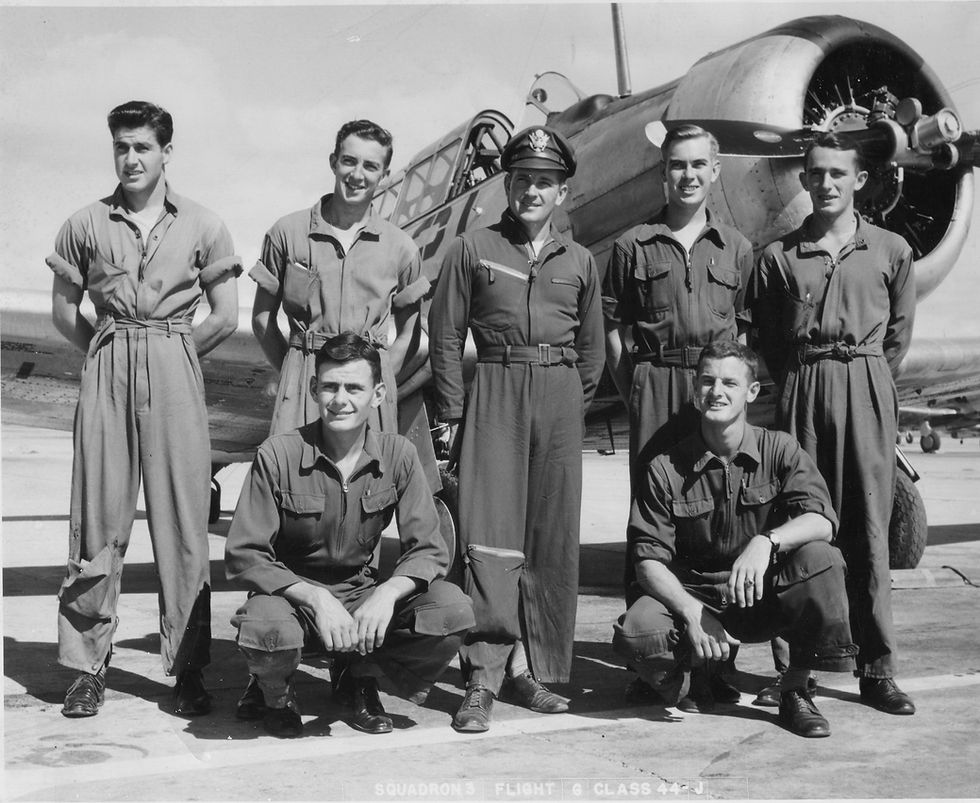
In the late 1930s, while Europe became embroiled in another war, General Henry H. “Hap” Arnold sat at the head of the United States Army Air Corps and did the math. He didn’t like the answer.
The Army was training a few hundred pilots a year. There were fewer than 7,000 commercial pilots in the entire country. In a general war — the kind every serious professional soldier in Washington could feel coming after the Munich Agreement in September 1938 — a few hundred pilots a year was nothing. It was less than nothing. It was an engraved invitation to lose.
Arnold believed, correctly, that the first thing you do when you need an air force is teach a lot of young men to fly. The second thing is build airplanes. The third thing is everything else. The United States was not going to have time to do any of it in the sequence an orderly mind would prefer. It was going to have to do all of it at once.
— THE TWO PROGRAMS —
Two different programs came out of this moment, and they are often confused with each other. They’re not the same.
The first was the Civilian Pilot Training Program — the CPTP. President Roosevelt announced it at a White House press conference on December 27, 1938, and Congress funded it in 1939. CPTP ran through colleges and universities. It paid for 72 hours of ground school and 35 to 50 hours of flight instruction for civilian college students. By the summer of 1944 it had run through more than 1,100 educational institutions and graduated 435,000 pilots. Its official justification was general aviation and economic stimulus. Its actual purpose was national defense, and nobody pretended otherwise. Several of The Collection’s aircraft served in this program.

The second program — the one that built Mustang Field — was the Army Air Corps’ Contract Primary scheme. This was Arnold’s own creation. In May 1939, his office notified nine civilian flight schools that they had been selected to provide primary training for Army aviation cadets. The War Department approved the plan in June. The first classes began in July. The Army paid the schools $1,170 for each cadet who completed primary, and $18 per flight hour for the ones who washed out.
CPTP trained civilians through colleges. Contract Primary trained Army cadets through private flight schools. Both programs mattered. They were different programs. And, again, several of The Collection’s aircraft served in this program.
By May 1943, the Contract Primary scheme had grown from nine schools to fifty-six. The cadets who flowed through those fifty-six schools would go on to fight the air war over Europe and the Pacific. And one of the first twenty-six schools in that system — and one of the most productive in the country — was in Oklahoma.
— ARNOLD’S ROOM —
In early 1940, Arnold called a number of flight school operators to Washington and put the problem to them directly. We have a problem. War is coming, and we don’t have enough pilots. The Army can’t build the training infrastructure fast enough. I need your help. We’ll provide the money, the airplanes, the check pilots, and the program. We’ll recruit the cadets and send them to you. You train them. Then we’ll make them officers.
The men left that meeting and went to work.
One of them was Clarence Edgar Page of Oklahoma City. Page was born on a farm south of Oklahoma City in 1897. He enlisted in the Army in 1918, learned to fly as an Army pilot in the closing months of the First World War, and came home to Oklahoma to build a life in aviation that would last the next seventy years. By the late thirties he was, by common consent, Mr. Oklahoma Aviation. On weekends he had barnstormed with Wiley Post, Bennett Griffin, and Orville “Red” Mosier. On weekdays he built businesses.
Page had been watching Spartan Aviation over in Tulsa, and he knew what a contract flight school looked like from the inside. He went to Washington to see if he could get one of Arnold’s contracts. Arnold gave him the go-ahead.

Page came home and, with three partners — Jerry Sass, Ted Colbert, and Johnny Burke — formed a company called Oklahoma Air College, Inc. They went looking for land west of Oklahoma City and found it in January 1941. They bought 240 acres. They called it Cimarron Field.

—SIXTY DAYS—
Land bought in January. Field dedicated March 23, 1941. First class graduated in May.
Read that again. In roughly two months — about sixty days — Oklahoma Air College took 240 acres of Oklahoma prairie and built hangars, barracks, mess hall, ground school buildings, the administration building, and a canteen, laid out a 20-acre asphalt warm-up field, and turned it over to the Army Air Corps ready to receive cadets. Eight months before Pearl Harbor.
This is the speed at which the prewar American aviation expansion moved. You can’t understand what comes next without understanding this: the people who built the contract primary system knew they were racing something, and they ran.

Cimarron was among the first twenty-six contract primary schools in the country. Four thousand and eighty-nine cadets graduated from it before it closed in August 1944. The aircraft they learned in was the Fairchild PT-19 — open cockpit, wood wings and tail, fabric-covered fuselage, a Ranger engine up front, and a lot to ask of a young man who had never flown. Over the flat prairie of Canadian County, day after day, the PT-19s went up and came down and went up again.
—ONE WAS NOT ENOUGH—
In the summer of 1942, with the country at war and the pilot pipeline straining, the USAAF came back to Clarence Page and asked him to train more. Page had already pushed Cimarron to the limit. There was no more room at Cimarron.
So he went seven and a half miles west, four miles south of El Reno, and built a second field.
He called it Mustang Field.

Mustang was operated by the 320th AAF Flying Training Detachment under contract with Page’s operation. At peak training each of the two bases had at least 500 cadets, 100 PT-19s, and all the instructors and mechanics they took to keep them flying. Between Cimarron and Mustang, Clarence Page’s Oklahoma Air College trained 8,500 Army pilots before the contract primary program wound down in 1944.
Mustang Field ran for roughly eighteen months. It closed in the summer of 1944, when the Army finally had more pilots than it needed.
But before it closed, Oklahoma Air College had to build it. And what they built — on the same breakneck timeline as Cimarron, with the same prefabricated ingenuity — included four of the most remarkable industrial buildings I’ve ever stood inside.
That’s the next story.

— COME SEE THE STORY —
The Caldwell Collection at Mustang Field is open every Tuesday - Friday from 10am-4pm and Saturday from 10 am to 2 pm — no appointment required, and admission is always free. We’re at 6600 S. Mustang Field Road, Hangar 3, El Reno, Oklahoma, at El Reno Regional Airport.
▸ The Museum: thecaldwellcollection.org
▸ About Me: tonycaldwell.net
▸ The Dream Wacos Collection: dreamwacos.com
▸ Contact: info@thecaldwellcollection.org
The Caldwell Collection at Mustang Field is a 501(c)(3) nonprofit established in 2024. Aircraft donations are tax-deductible; consult your tax advisor.


Comments